
Film Review: WAKE UP DEAD MAN (2025)
The gentleman sleuth returns to bless our screens.
The good news: November was quite the busy month for yours truly, full of new milestones and accomplishments. The bad news: those accomplishments did not include finding the time to read and write as much as I wanted.
On the last day of the month, however, I had the privilege of enjoying a very special experience. As luck would have it, I found a single theater in my hometown participating in the limited theatrical run for one of this year's most anticipated films: Rian Johnson's Wake Up Dead Man, the newest installment of the Benoit Blanc Mysteries. With the film now available on Netflix, I've decided to give my thoughts on how this whodunit compares and contrasts to the rest of the series—emphasis on contrast. Because while Wake Up Dead Man is built on classic mystery fundamentals like its two predecessors, the picture it paints is both darker and thematically richer.
NOTE: This review will contain some mild spoilers.
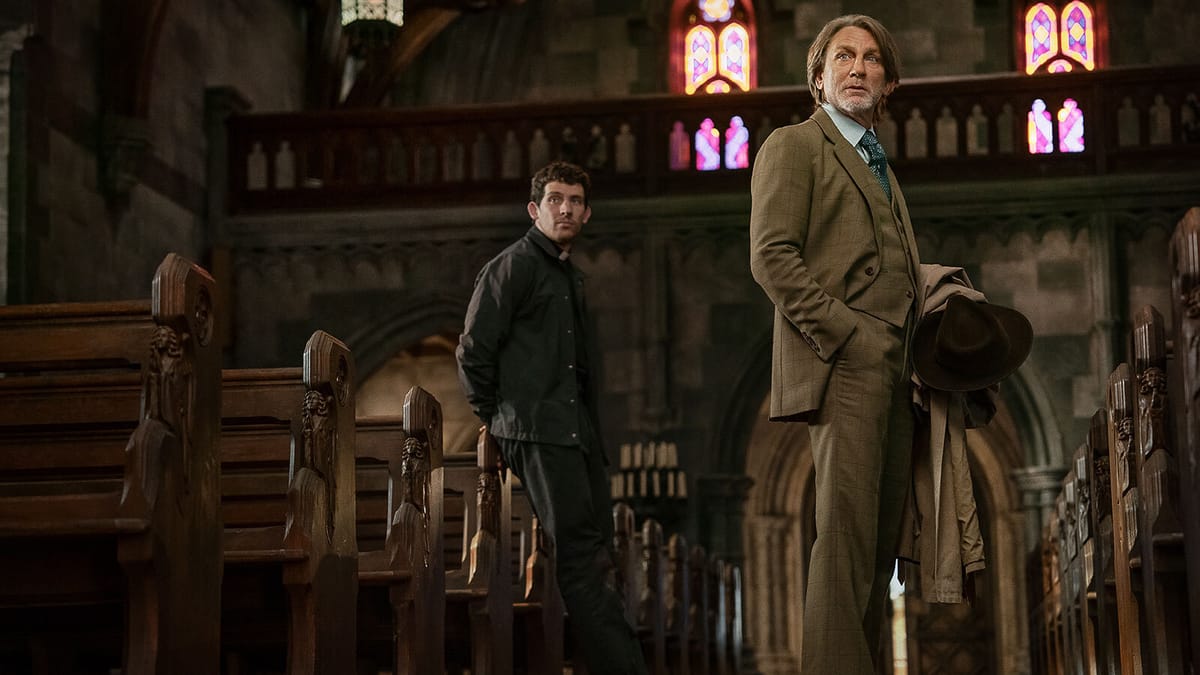
The Plot: World-renowned gentleman detective Benoit Blanc (Daniel Craig) is confronted with his most tangled mystery yet when a small Catholic church in upstate New York is rocked by a seemingly impossible crime. Monsignor Jefferson Wicks (Josh Brolin), the bigoted and charismatic priest who runs Our Lady of Perpetual Fortitude with an iron fist, has dropped dead of a stab wound in the middle of Good Friday service, standing in the middle of an empty closet. The main suspect is Wicks's subordinate Reverend Jud Duplenticy (Josh O'Connor), a young man with a checkered past and a known hatred of Wicks. But Jud insists that he is innocent, and Blanc believes him. Distrustful of the Church but tempted by the chance to solve a locked-room murder, the detective sets out to clear Jud's name and determine which of the church's regulars is the real killer. But like in every good mystery, the truth isn't so easy to find. While they unearth dark secrets and sinister motives stretching back decades, Blanc and Jud start to turn on each other as they debate the value of religious faith vs. logic and reason. Blanc believes that unmasking Wicks's murderer will be a symbolic victory of enlightenment over ignorance, but as the path to the truth grows ever darker, he might just realize that this is one case he isn't meant to solve…
Few people expected Knives Out to become a major hit when it released in late 2019. It was a mid-budget adult comedy amidst a sea of family-friendly blockbusters, its writer/director had been raked over the Internet's coals for his Star Wars film The Last Jedi, and it was a deliberate throwback to the antiquated whodunit tales of decades past. But it became one of the most acclaimed films of that year, securing an Oscar nomination for Best Original Screenplay, and ultimately made over $300 million against a $40 million budget. Reviewers celebrated the film for its witty humor, sharp social commentary and compelling central mystery, while Craig's performance as Benoit Blanc marked the arrival of a beloved new fictional detective.
A second Blanc film was announced in early 2020, and its distribution rights were quickly snatched up by Netflix, providing the budget for both that film and an additional sequel. The result was 2022's Glass Onion, a bigger and more boisterous adventure that charmed some viewers but disappointed others with its outlandish tone and relatively simple mystery. The villain in that film is easy to spot from the beginning, and Blanc's climactic summation is not about unraveling their master plan but about realizing that yes, they are stupid enough to commit a crime that will immediately be linked to them.
In some ways, Wake Up Dead Man is a return to form for this series. It goes back to the rural New England setting of the original film, and the main plot takes explicit inspiration from Golden Age mystery novels. The Hollow Man by John Dickson Carr is repeatedly referenced throughout the script, alongside works from Dorothy Sayers and Agatha Christie. But in many ways—the parts that matter most—this film is a very different beast from both Knives Out and Glass Onion.
Something that Rian Johnson and his collaborators have excelled at is giving each Benoit Blanc film a distinct tone and visual identity. Knives Out takes place in a sprawling country manor with an autumnal color palette, a perfect backdrop for its cast of dysfunctional family members. Glass Onion is a glamorous summer vacation to a billionaire's private island, dominated by futuristic whites and oceanic blues. Wake Up Dead Man, by contrast, is a film infused with moody, Gothic dread. From its opening moments, which are scored with unsettling strings and lit with flickering firelight, you know that you're in for something darker than Blanc's previous adventures. Its story unfolds in shadowy parlors that bear witness to clandestine meetings, moonlit forests beset by storms, ominous crypts hiding long-buried secrets behind their impenetrable doors. One early sequence is even an homage to Bram Stoker's Dracula, something that warms my horror-loving heart.
The real visual centerpiece of the film is the church itself. It's a masterpiece of unsettling set design, a place filled with the architectural equivalent of open, festering wounds. The most striking piece of imagery, one that comes to dominate the film, is the cross above the altar—or rather, the shadow on the wall where the cross should be. The absent cross and the story behind it are symptoms of the rot within Our Lady of Perpetual Fortitude, exposing the fact that it's no longer a house of God but a temple dedicated to the worship of Monsignor Wicks himself.
In short, it's the perfect backdrop for a story about the messy and multifacted nature of religion.
One of the standout scenes in the film happens around the 40-minute mark, just as Benoit Blanc makes his grand entrance into the story (yes, it takes that long for him to properly appear, but I promise you won't even notice the wait). As Blanc and Jud first meet, their conversation turns to the topic of the Church, with a capital C.
Blanc pulls no punches when giving his opinion: "It's like someone has shone a story at me that I do not believe," he says. "It's built upon the empty promise of a child's fairy tale, filled with malevolence and misogyny and homophobia…hiding its own shameful acts…I want to pick it apart and pop its perfidious bubble of belief and get to a truth I can swallow without choking." As he speaks, the lighting in the scene turns gray and cold.
But then Father Jud speaks, and his answer changes the tone of the whole scene. "You're right. It's storytelling…I guess the question is, do these stories convince us of a lie? Or do they resonate with something deep inside us that's profoundly true, that we can't express any other way except storytelling?" And lo and behold, a golden light comes shining through the church windows again.
This push and pull about the impact of religious institutions, the way that both these viewpoints are true at once, is the beating heart of Wake Up Dead Man. Johnson has no qualms about showing all the ways religion can be an instrument of corruption and harm. Wicks uses his position as a priest to spread bigotry, manipulate/exploit his parishioners and build a cult of personality around himself. The misogyny that Blanc alluded to comes up again and again as more of the church's ugly secrets are revealed: the men who run the community rely on the efforts of women who get no recognition for their obedience and sacrifices, and the women who dare to show defiance or stand up for themselves are shamed and cast aside. It's not a pretty picture—but it's not the full picture, either.
Fans of this series know by now that Benoit Blanc is never actually the protagonist in a Benoit Blanc movie. He's there to solve a crime, of course, but it's always his Watson, the innocent he chooses as his assistant, who moves the story forward and has a complete story arc by the end. In this aspect, Wake Up Dead Man is no different from its two predecessors. Father Jud is our protagonist, and he might just be the most fascinating and complicated one this series has given us so far. For one thing, there's some real darkness to the character that deepens his internal conflict. We learn early on that he's a former boxer who became a priest after killing a man in the ring. While he refuses to let his violent instincts dictate his actions, he doesn't suppress that part of himself, and he's not above succumbing to those instincts in moments of anger. And do you remember Marta in Knives Out, how she was so pure-hearted that telling a single lie made her vomit? Jud does not have that problem.
But coexisting with the darkness is a well of optimism and empathy despite hardship. If Wicks is a portrait of all the worst beliefs and practices that religion can encourage, Jud embodies all the good that it's capable of. He believes that the church should be the "daily bread" of its parishioners, a community that welcomes and sustains people instead of isolating them with bigoted fearmongering. And just as Marta is an archetypal example of a good nurse, Jud is the archetype of the good priest. In a scene about halfway through the story—the most gutwrenching, emotionally intense scene in the whole film—he ends up on the phone with a woman who tearfully asks him to pray for her dying mother. Despite being in the midst of a murder investigation, knowing that he stands to lose everything if he can't clear his name, Jud handles this situation with all the empathy and care that he can muster.
In a time where many depictions of Christianity in film are "faith-based" movies that barely disguise their purpose as Christian Nationalist propaganda, Wake Up Dead Man's honesty and curiosity about religion makes it one of the most compelling religious films of the last several years. Rian Johnson has spoken about growing up in the Evangelical church but separating from it as an adult, and so he comes at the "believer vs atheist" conflict as someone who's been on both sides of that divide. Both Blanc and Jud are depicted not as strawmen spouting talking points but as people whose ideologies have been shaped by their lived experiences. It makes sense that Blanc, a queer man who values empirical reasoning and has sided with marginalized people against powerful authority figures, would be critical of Christianity and the Catholic Church. Likewise, Jud's unwavering faith comes from the fact that he has firsthand knowledge of how religion can help a person atone for their crimes and turn their life around. Neither man successfully converts the other to his worldview, nor do they even try—that's not the point of the story. The point is that they each learn something from the other, and they are both changed by the adventure that they share.
If this film is starting to sound like some joyless mystery drama, don't be frightened: it's still very funny. There are sight gags, witty satire, musical theater jump scares, Blanc solemnly uttering the phrase "Scooby Dooby Doo" and a quick Star Wars reference that will make you burst out laughing if you're familiar with Rian Johnson's filmography.
The cast is, of course, a delight to watch. Daniel Craig never looks more alive as a performer than he does when playing Benoit Blanc, and in all three of these movies, you can feel his genuine love for this character. Josh O'Connor's wonderful performance is the glue that holds the movie together; the role of Jud requires an actor who can not only be on equal footing with Blanc but outshine him at critical moments, and O'Connor succeeds at both. Kerry Washington is great as the put-upon lawyer Vera Draven, getting to utter my favorite line in the movie when she says that a certain grievance is "one verse in the Bible of my bitterness." To say anything more about specific characters/performances would be edging towards spoiler territory, so I'll just say that everyone is excellent. If there are any weak links in the cast, it's only because they play minimal roles in the story. Characters like Andrew Scott's unhinged sci-fi writer and Cailee Spaeny's disabled cellist are mostly relegated to the sidelines and feel underutilized as a result. The script's focus doesn't move across the whole ensemble quite as smoothly as it does in Knives Out and Glass Onion.
Another criticism I've seen directed towards the film concerns its plotting, and I do get where that critique is coming from. The central mystery is complicated and thorny, and Blanc's investigation in the second act can start to feel meandering as he gets derailed by new plot developments and arguments with Jud. Not having Blanc enter the story until the end of the first act is also a risky choice: if the viewer doesn't like the new characters, they'll just be waiting around for Daniel Craig to show up rather than getting invested in the plot. But in my mind, those elements of the film are features and not bugs. I will admit that Knives Out has the most straightforward and neatly assembled screenplay of the three films, and that's because it is the series' most straightforward example of a murder mystery. Once Johnson establishes his formula in that film, he starts to play with it in Glass Onion and Wake Up Dead Man. The former tells its story through reflections and repetition and is about seeing through the illusion of genius that powerful people construct around themselves. The latter is about exploring the parallels between a locked-room mystery and a holy mystery, how a detective and a priest both have their own kinds of doctrine, and the importance of both reason and faith when confronted with the seemingly impossible. Most of all, it's about being guided by something bigger than yourself and using that thing to gain a greater understanding of the world.
So I understand why Wake Up Dead Man makes the story choices that it does. Not only that, I think the bold risks it takes help make it my favorite installment of the series. By exploring the intricacies of the mystery genre and the mythmaking of Christianity, it reminds the viewer that we humans are bound together by our need for stories. Stories to instruct us, give us catharsis, give us something to aspire to. The detective giving his summation and the priest giving his sermon are both storytellers—and so is the director making his film. The cinema is a church, and we viewers are the parishioners. And with Wake Up Dead Man, Rian Johnson has given us one hell of a Sunday service.
There will be more film reviews coming in 2026, along with Book of the Month posts, essays and short fiction! Subscribe to my newsletter to enjoy it all!
—Dana